
Marginal Revenue Product Analysis for the 2019 NBA Champion Toronto Raptors
Were players overpaid or underpaid?

Much of the sports economics literature over the years has focused on player salaries, and specifically whether or not they are paid fairly. This paper will conduct an analysis of the 2018-2019 champion Toronto Raptors roster to see how players who were with the team for the entire regular season and playoffs were paid relative to their marginal revenue products. To do so, player impact plus/minus (PIPM), an advanced basketball statistic developed by Jacob Goldstein, will be used in addition to a modified version of the Scully method for linking player performance to team revenue.
Team Context
The team context is important to understand for this particular Toronto Raptors season. Before the season began, the Raptors made a huge gamble and traded their long-time star player DeMar DeRozan in addition to Jakob Poeltl to the San Antonio Spurs for Kawhi Leonard and Danny Green (Strong 2018). It was an all-or-nothing bet on winning a championship that very season, as Leonard had shown no interest in playing in Toronto and only had one year left on his contract (Strong 2018). The season also had other storylines, including the continued leadership of Kyle Lowry and the rise of Pascal Siakam into a key starting player. Further trades also occurred, with Jonas Valančiūnas, C.J. Miles, and Delon Wright traded to the Memphis Grizzlies in exchange for Marc Gasol in February 2019 (Marks 2019). Since the Raptors’ explicit intention was to make a deep playoff run during the 2018-19 season, it only makes sense to analyze the contributions of players in line with that reality. For that reason, regular season and playoff statistics have been combined and players who spent the entire regular season and playoffs with the Raptors were included in the analysis. These players are Pascal Siakam, Danny Green, Kyle Lowry, Kawhi Leonard, Serge Ibaka, Fred VanVleet, and Norman Powell.
Player Impact Methodology
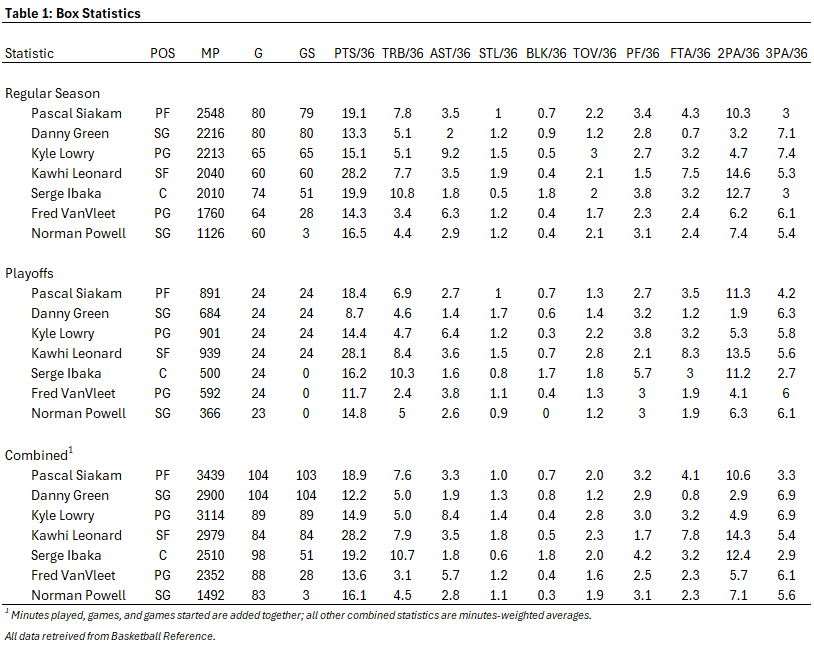
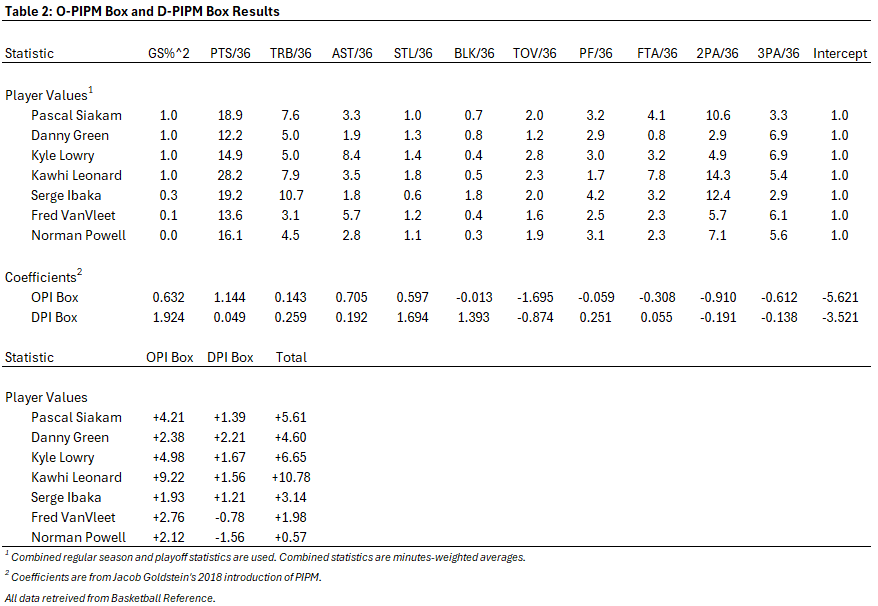
To determine whether players were over or underpaid, their salaries were compared to their estimated marginal revenue products (MRPs) for the 2018-19 season. Player performance was summarized using the player impact plus/minus (PIPM) statistic developed by Jacob Goldstein. PIPM combines on/off court data and box score statistics to evaluate a player’s overall contribution to team performance, which can be difficult to discern given that basketball is a complex invasion sport. The box metrics of interest include the percentage of games started squared for each player, as well as common statistics such as points, rebounds, and assists, all per 36 minutes; these raw metrics can be viewed in Table 1. All player metrics that are per 36 minutes are minutes-played-weighted averages between the regular season and playoffs. Regression results from Goldstein’s work were used, including the intercept and coefficients for the metrics of interest. These were used to find Offensive-PIPM Box and Defensive-PIPM Box statistics. Among the players analyzed, Kawhi Leonard had by far the best O-PIPM Box score of 9.2, while Danny Green had the best D-PIPM Box score of 2.2. Interpreting these results, Leonard being on the floor raised the Raptors’ scoring per 100 possessions by 9.2 points on average, while Green being on the floor lowered the Raptors’ opponents’ scoring per 100 possessions by 2.2 points on average. Green’s results are expected, as he is known as a “3 & D” player (Herbert 2024), meaning his distance shooting and defensive skills were above average. These results also highlight just how crucial the acquisitions of Green and Leonard were for the Raptors that season. Full O-PIPM Box and D-PIPM Box results are available in Table 2.
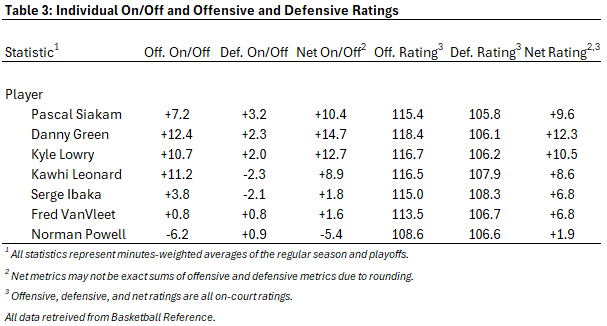
The overall PIPM metric also contains offensive and defensive on/off ratings and overall offensive and defensive ratings. On/off ratings show how much better the team actually scored and defended during games with a given player on the floor vs off. Overall offensive and defensive ratings show how many points per game were scored by the Raptors and their opponents, respectively. Net ratings represent the difference between a player’s offensive and defensive rating. Among analyzed players, Danny Green had the highest net rating of +12.3 and also the best net on/off rating of +14.7. These statistics are all available in Table 3.
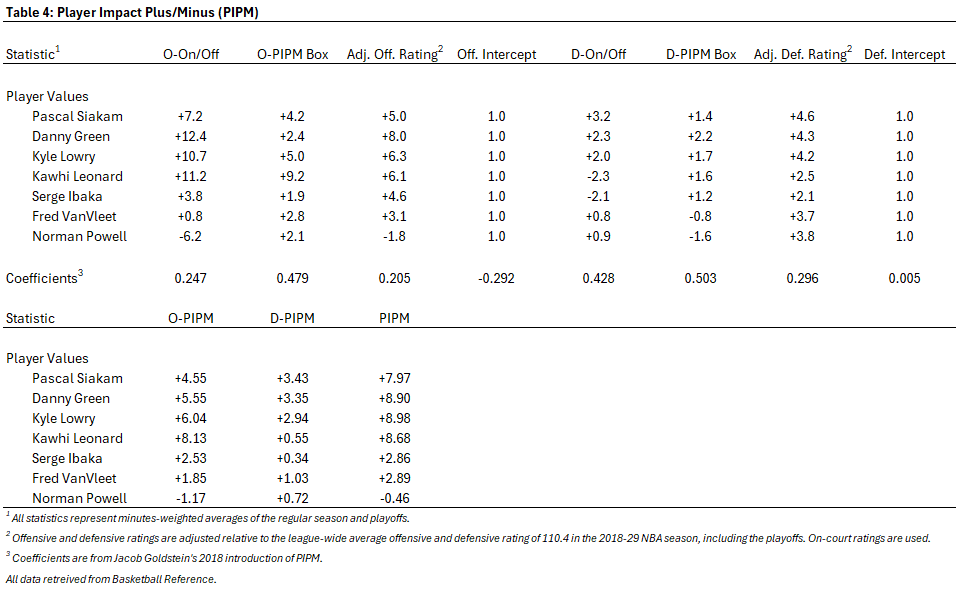
PIPM then combines the O-PIPM and D-PIPM Box scores, offensive and defensive on/off statistics, and offensive and defensive ratings to find the overall PIPM statistic for each player. Adjusted offensive and defensive ratings are used to capture the difference between a player’s rating and the league average. The average rating for teams in the 2018-19 regular season was 110.4 points, while the average rating in the 2019 playoffs was 110 points, reflecting lower scoring in the playoffs where only the best teams are playing each other. Taking a games-played-weighted average of the two, the result rounds back to 110.4, so that average rating was used for the purposes of the analysis. Similar to the O-PIPM and D-PIPM Box analysis, Goldstein’s coefficients were used to assign value to each of these statistics. The highest O-PIPM among players analyzed was Kawhi Leonard with 8.13, the highest D-PIPM was Pascal Siakam with 3.43, and the highest overall PIPM was Kyle Lowry with 8.98. The interpretation of Lowry’s PIPM is that the Raptors would have been an 8.98 point differential worse off on average if they replaced Lowry with a league-average player. Full PIPM results are available in Table 4.
Player MRP Methodology and Results
To use PIPM results to find a player’s MRP, a modified version of the Scully method was used. First, PIPM was linked to wins, which were then linked to revenue. The league average points scored of 110.4 was again used, and then a player’s O-PIPM and D-PIPM were added to and subtracted from this number, respectively. This theoretical average point differential was then used to calculate a win percentage per 100 possessions, using a formula and coefficient from Goldstein’s work. The win percentages were then used to find each player’s wins above replacement (WAR), following from the assumptions that an entirely replacement-level team would win ten games in a season and that there are approximately 100 possessions in a 48 minute NBA game. The player with the highest WAR was Pascal Siakam, who, if he was substituted for a replacement-level player on an entirely replacement-level team, would generate an extra 21.9 wins for said team. Full win percentage and WAR results are in Table 5.
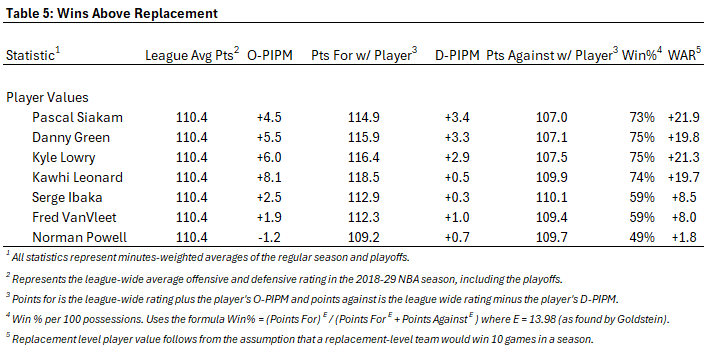
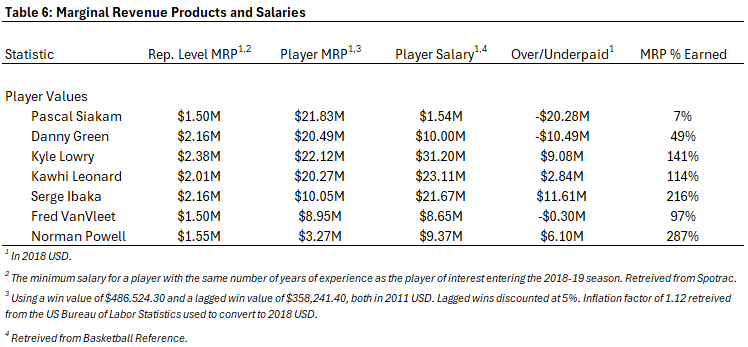
WAR was then used to calculate each player’s MRP. Using regression results from Berri, Leeds, and von Allmen (2015), current and lagged dollar values ($486,524 and $358,241 2011 USD, respectively) were assigned to wins. Assuming that the MRP of a replacement level player is equal to the minimum salary for a player with a given number of years of experience in the league, MRP was calculated for each player. Leonard, Lowry, Green, and Siakam all had similar MRPs between $20.3m and $22.1m 2018 USD, with Lowry’s being the highest. This highlights that the Raptors had distributed contributions not only on the floor, but also in terms of team revenue generation.
Comparing estimated MRPs to salaries, it becomes clear that salaries were not very representative of MRPs for the players analyzed. Pascal Siakam only earned 7% of his estimated MRP of $21.8m, as he was still on a rookie-scale deal at the time and also improved his skills immensely during the 2018-19 season, winning the league’s Most Improved Player award (Basketball Reference, n.d.). Danny Green was also underpaid, only earning 49% of his estimated $20.5m MRP that season. Conversely, Norman Powell and Serge Ibaka were the most overpaid, earning 287% and 216% of their respective estimated MRPs. Fred VanVleet and Kawhi Leonard’s salaries were the closest to their MRPs, with them earning 97% and 114% of their estimated MRPs, respectively. Full MRP calculations and analysis is in Table 6.
Discussion and Conclusion
As mentioned, the results show that player salaries did not accurately reflect MRPs in most cases among the players analyzed on the 2018-19 Toronto Raptors. Some specific explanations are available; Siakam’s rookie-scale contract has already been discussed but another example is Serge Ibaka’s role change during the season. After the Raptors traded Jonas Valančiūnas and received Marc Gasol, Ibaka’s role shifted from a shared-time starting center to a more explicit second option behind Gasol (Harper 2019). However, his contract reflected the previous dynamic, and his reduced opportunity to contribute post-Gasol trade makes him appear to be more overpaid than he otherwise might. In general, the methodology used here does a poor job accounting for significant roster and role changes during the season. There will also inevitably be some market inefficiency when comparing salaries with MRPs that are calculated after-the-fact; idiosyncrasies such as injuries can vastly change a player’s impact. An example is OG Anunoby, who was with the Raptors for the entire 2018-19 campaign, but was left off of the playoff roster due to injury (Basketball Reference, n.d.), leading him to be excluded from this analysis. Kawhi Leonard’s load management is also poorly accounted for, with his “clutch” contributions much more weighted towards the playoffs compared to his teammates. The Scully method also doesn’t account for the long-tail effects of winning a championship on franchise valuation, reputation, and prestige, which the Raptors certainly felt after winning in 2019 (Lima et al. 2023).
Bibliography
“2018-19 NBA Season Summary.” n.d. Basketball Reference. Accessed November 27, 2024. https://www.basketball-reference.com/leagues/NBA_2019.html.
“2018-19 Toronto Raptors On/Off.” n.d. Basketball Reference. Accessed November 27, 2024. https://www.basketball-reference.com/teams/TOR/2019/on-off/.
“2018-19 Toronto Raptors Roster and Stats.” n.d. Basketball Reference. Accessed November 27, 2024. https://www.basketball-reference.com/teams/TOR/2019.html.
“2018-19 Toronto Raptors Transactions.” n.d. Basketball Reference. Accessed November 27, 2024. https://www.basketball-reference.com/teams/TOR/2019_transactions.html.
“2019 NBA Playoffs Summary.” n.d. Basketball Reference. Accessed November 28, 2024. https://www.basketball-reference.com/playoffs/NBA_2019.html.
Berri, David, Michael Leeds, and Peter von Allmen. 2015. “Salary Determination in the Presence of Fixed Revenues.” International Journal of Sport Finance 10 (1): 5–25.
“CPI Inflation Calculator.” n.d. US Bureau of Labor Statistics. Accessed November 27, 2024. https://data.bls.gov/cgi-bin/cpicalc.pl?cost1=1&year1=201110&year2=201810.
Goldstein, Jacob. 2018. “Nylon Calculus: Introducing Player Impact Plus-Minus.” FanSided. January 11, 2018. https://fansided.com/2018/01/11/nylon-calculus-introducing-player-impact-plus-minus/.
Harper, Zach. 2019. “Grade the Trade: Raptors Make Big Play by Acquiring Marc Gasol from Grizzlies.” The New York Times, February 7, 2019. https://www.nytimes.com/athletic/805938/2019/02/07/grade-the-trade-raptors-make-big-play-by-acquiring-marc-gasol-from-grizzlies/.
Herbert, James. 2024. “Danny Green Retires from NBA, but Three-Time Champ -- and Quintessential 3-and-D Guy -- Remains an Archetype.” CBS Sports. October 10, 2024. https://www.cbssports.com/nba/news/danny-green-retires-from-nba-but-three-time-champ-and-quintessential-3-and-d-guy-remains-an-archetype/.
Lima, Michael, Mai Nguyen Le, Mnishi Sharma, and Mnishi Vidhu. 2023. “Canada’s First NBA Championship Has Long Term Benefits for the Toronto Raptors.” Seneca Journalism (blog). April 20, 2023. https://www.senecajournalism.ca/canadas-first-nba-championship-has-long-term-benefits-for-the-toronto-raptors/.
Marks, Bobby. 2019. “Memphis Grizzlies to Trade Marc Gasol to Toronto Raptors.” ESPN. February 7, 2019. https://www.espn.com/nba/story/_/id/25945881/memphis-grizzlies-trade-marc-gasol-toronto-raptors.
“NBA Minimum Salaries.” n.d. Spotrac. Accessed November 27, 2024. https://www.spotrac.com/nba/cba/minimum.
Strong, Gregory. 2018. “Raptors, Spurs Complete Blockbuster Swap of All-Stars DeRozan, Leonard.” CBC Sports, July 18, 2018. https://www.cbc.ca/sports/basketball/nba/nba-raptors-demar-derozan-trade-1.4751387.
This writing was originally submitted as coursework at the University of Toronto. It was only posted online after being fully graded and returned, although the post may be backdated to better reflect when it was actually written.